
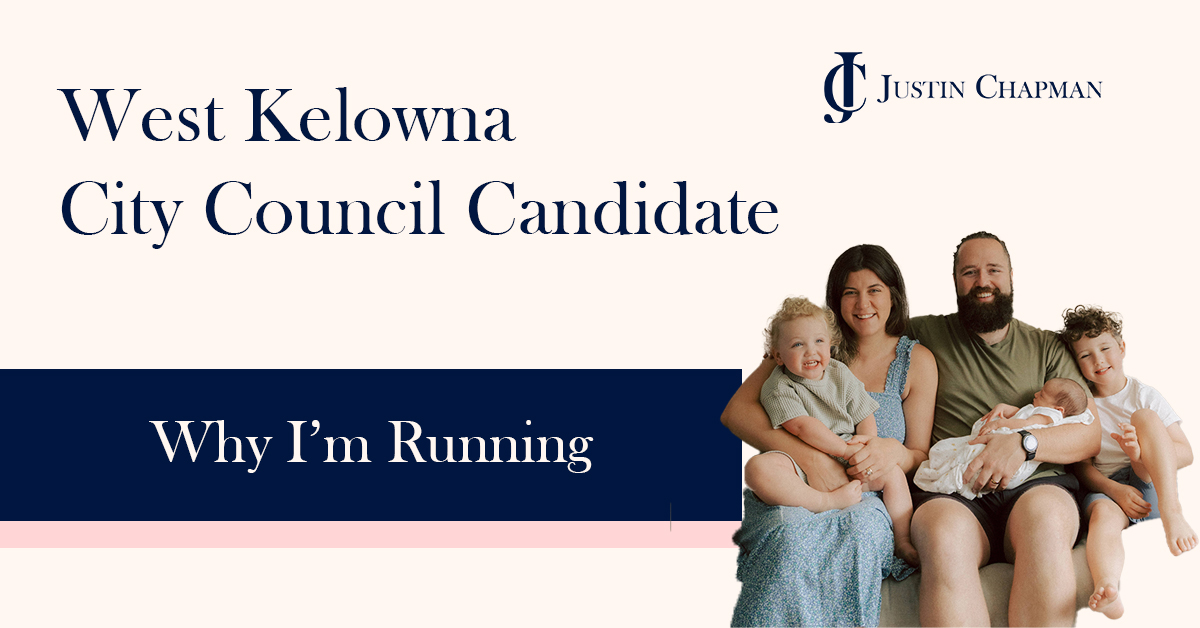
I am running for West Kelowna city council in the general local election on Saturday, October 17, 2026. My candidate page has the short version of why. This is the long one, because a paragraph on a webpage does not really explain why a guy with a full-time job, two side businesses, and young kids at home decides to add this to the pile.
The West Kelowna city council election is a small ballot with a long shadow, and I want to be honest about my reasons for being on it. There are three. My family is growing up here. The math of an ordinary life in this valley has stopped working the way it used to. And when council needs a lower tax number, the first thing cut is people, not process. I think that is backwards.
Reason one: my kids are growing up here
I was born in Vancouver and I have been in the Okanagan since I was five. I did not move here for the view, and I am not passing through. Raising a family in West Kelowna is the whole reason I filled out the paperwork, and every decision council makes over the next four years lands on them longer than it lands on me.
That is not a sentimental point, and it is the main thing separating me from a protest vote. It changes what you optimize for. If you are here for five years, you want the tax rate low this year and you do not much care what the water system looks like in 2040. If your kids are going to learn to drive here, you care about both, and you have to be honest that those two things pull against each other.
What I want for them is the reason I am running for West Kelowna city council rather than writing letters about it, and it is not complicated. Beaches and trails they can get to without a car ride. Fields and courts that are open and maintained. A library, a rec centre, and a downtown that is worth walking through. The valley already does the hard part. Nobody has to invent the lake or the hills. Our job is to not get in the way of them, and to keep the built stuff around them working.
Small town feel, big city services, without the big city bill
That is the version of West Kelowna I want, and I know how it sounds. Everybody wants everything for less. The reason I think it is achievable here is that we are still small enough to change how we operate without a two-year restructuring project. A city of 40,000 can fix a broken process in a quarter. A city of 400,000 forms a committee.
Growing costs money, and I am not going to pretend otherwise. But a lot of what people experience as bad service is not underfunding. It is a form that goes to the wrong desk, a permit that sits in a queue, a phone call that ends with someone taking a message. Residents do not experience a budget. They experience a wait.
Reason two: I want the 1990s math back
Here is the concept I keep coming back to. In the 1990s, a fairly ordinary household in this country could own a fairly ordinary home. Not a big one. Not a nice one. A home. Two working parents could put steak on the table on a Friday without it wrecking the week’s grocery budget, and the property tax bill was an annoyance, not a line item people restructure their year around.
I am not nostalgic about the decade. Interest rates were ugly and plenty of people had it hard. What I want back is the ratio. The idea that a normal job in a normal town buys a normal life, and that the local government’s share of your income stays proportionate to what it hands back to you.
Anyone running for West Kelowna city council should be upfront here: a councillor cannot fix grocery prices, mortgage rates, or the price of a detached home on the Westside. Anybody telling you otherwise on a doorstep is selling something. What a councillor can actually touch is the municipal share. The tax increase. What it costs to get a permit and how long you wait for it. What the city pays for services and whether anyone has checked that number in six years. Housing supply, through what council approves and how fast. Those are real levers and they are the ones I would pull.
What a home used to cost, in years of income
I did not want to put a feeling on a lawn sign, so I went looking for the number. Coldwell Banker Horizon Realty put together a history of Canadian house prices against wages from 1981 to 2025 that lines it up clearly, drawing on CREA and Statistics Canada data.
From 1980 to 2001, Canadian home prices sat in a narrow band of roughly three to four times provincial annual median income. Vancouver and Toronto had their own bubbles, but for most of the country that was the ratio. Today it runs closer to seven to ten times income, and at the 2022 peak the national measure hit 16.
Wages did not sit still, they just moved slowly. Statistics Canada reports that median real hourly wages grew about 20% between 1981 and 2024, with most of that after 2003. From 1981 to 1998 the increase was roughly 4%. Prices did not grow 20%. They multiplied.
One honest caveat. Different sources measure this ratio differently, using average price against median income, or a household versus a person, so the numbers move around depending on the method. That is why I am giving you ranges instead of a single decimal. The direction is not in dispute.
The 1990s also had 12% mortgage rates, so I am not telling you it was easy. But I would take a 12% mortgage on a $150,000 house over 4.2% on a $950,000 one, and it is not close.
| $150,000 home at 12% | $950,000 home at 4.2% | |
|---|---|---|
| Down payment, 15% | $22,500 | $142,500 |
| Amount borrowed | $127,500 | $807,500 |
| Monthly mortgage payment | $1,316 | $4,336 |
| Interest paid over 25 years | about $267,000 | about $493,000 |
| Property tax, annual | about $650 | about $4,100 |
| Mortgage plus property tax, monthly | about $1,370 | about $4,678 |
My own calculations. Mortgage figures use Canadian semi-annual compounding and a 25 year amortization, and leave out mortgage default insurance, which applies to both at 15% down. The tax figures apply today’s West Kelowna rate, about $4.31 per $1,000 of assessed value, to both homes. That comes off my own tax notice. Treat these as estimates and check yours against your own bill.
The payment more than triples. The down payment you have to save first goes from $22,500 to $142,500, which is the part that actually locks people out. A high rate on a small number is survivable. A low rate on a huge number is a different kind of trap, because the debt does not shrink when rates move.
The tax line is the part I want council to look at. I ran it off my own notice, which works out to about $4.31 per $1,000 of assessed value. Hold that rate steady and the bill still climbs from roughly $650 a year to roughly $4,100, because the bill is a percentage of an assessment that has multiplied. Nobody voted for that increase. It arrived with the assessment notice. Then every annual increase council approves compounds on top of the bigger number, which is why 6.638% in 2026 takes more out of a household than the same percentage did fifteen years ago.
A household used to be able to see a path from a normal job to a normal home, and that path is what has gone missing. West Kelowna property taxes stack on top of a budget that is already carrying a much bigger housing number than it used to. That is the context every tax vote lands in, and I would rather council say that out loud.
Reason three: efficiency starts with training, not cuts
This is the third reason I am running for West Kelowna city council, and it is the part I actually do for a living. I am the Chief Operating Officer at CanScribe Career College, where I own marketing, admissions, student services, IT, and accounting. I also run a small marketing agency and an e-commerce shop. The common thread is operations: finding the step that takes longer than it should, and fixing it.
I came up through online education, so I have watched what happens when you give people real training and real tools instead of asking them to work harder with what they have. It is the single most reliable return I have ever seen. Better than new software, better than more headcount, and dramatically cheaper than both.
What the 2026 budget actually cost us
Look at how this year went. West Kelowna property taxes were headed for an 8.6% increase in the draft 2026 budget. Council took it to 7.6% over two days of deliberations, then asked staff to find another point, and in March adopted the 2026 to 2030 Financial Plan at 6.638%. Kelowna, next door, adopted 4.40% on a much larger budget.
Getting from 7.6% down to 6.638% is good work by council. I want to be fair about that. But look at how it was found. Reporting from Castanet on the March vote describes the chosen option as eliminating a requested parks position and a requested bylaw officer, and councillors themselves called it a deferral onto the next council.
That is the trade everyone assumes is the only one available. You either pay more or you get less. I do not accept that it is the only one, because I have spent fifteen years finding the third option, and it is almost always in how the work is organized and how well the people doing it are equipped.
What training did to a team I ran
A concrete one. When I led the marketing and admissions funnel at CanScribe as Vice-President, our connection rate, the share of prospective students we actually reached, was 10.2%. We were not short on leads. We were short on knowing which ones were ready and what to say to them.
I trained the reps on buying signals and on matching the message to the stage the person was actually at. Connection rate went to 41.4%. Conversion went from 8.33% to 11.5% and the sales cycle went from 3.2 months to 1.8. Same team. Same budget.
Around the same period we replaced the CRM, the LMS, and the phone and texting platform, and time to technical resolution fell 50%. Students got answers faster and nobody lost a service. Later, at Focus College, I built a Keap instance from scratch with proper conversion tracking and cost per conversion dropped 73.8% while leads went up 121.5%. None of that came from cutting anything.
City staff are residents. They pay the same taxes and sit in the same lineups, and they already know exactly where the process wastes their day. My instinct would be to ask them for that list first, before a consultant gets a purchase order, and then clear the way so they can fix it. Give people the tools and the training and you get a better West Kelowna for fewer tax dollars. That is not a slogan, it is just the pattern I keep watching repeat.
What running for West Kelowna city council does not mean
I should be straight about the limits, since running for West Kelowna city council seems to require everyone to claim expertise in everything.
I am not a planner, an engineer, or a lawyer. I am not a developer or a designer, although I did build and ship a live subscription software product this year using Claude Code, without writing the code myself. What I am good at is directing experts and AI tools, asking better questions, reading the data, and noticing when an answer does not add up.
I have also never held elected office. What I have done is chair a volunteer board mid-term when it needed someone, at Lake Country Youth Soccer Association, and run operations for organizations where the numbers were public and my name was attached to them. You can read more about my volunteer and board experience if you want the record.
One councillor is one vote out of seven. I am not going to promise you outcomes I cannot deliver alone. What I can promise is that I will ask what a program produced last year before I vote to fund it again.
What I am asking you for
The honest close on why I am running for West Kelowna city council is that I want the specifics. Tell me which interaction with the city cost you an afternoon it should not have. Tell me what you think we are overpaying for. Specific complaints are fixable. General ones just become talking points.
The short version of my platform is on my West Kelowna city council candidate page, and there is more on my background and work history if you want to check the receipts. If you want to talk, or you want to help, get in touch.
Voting day in the West Kelowna city council election is Saturday, October 17, and I will be at doors between now and then. Ask me the hard version of the question. I would rather have that conversation than a comfortable one.